
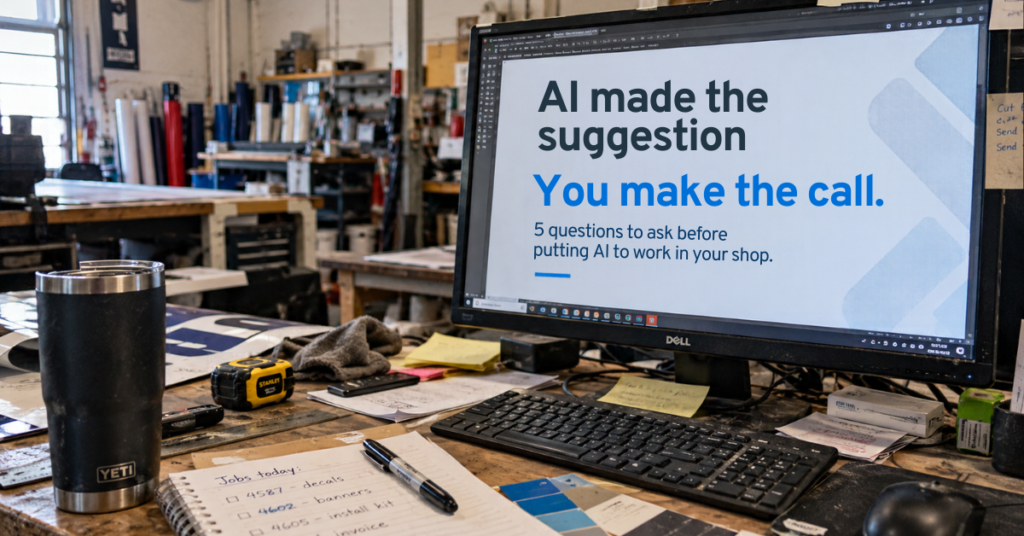
AI is already finding its way into print and sign shops, whether you’ve decided to use it or not.
Your customers are using it too.
Tools like ChatGPT, Claude and Gemini have made generative AI incredibly accessible. Customers are using AI to create artwork, logos, write copy and come up with ideas, then sending those files to you to produce.Spend any time in sign and print Facebook groups and you’ve probably already seen the conversations about how to handle AI-generated customer artwork. Tools like ChatGPT, Claude and Gemini have made generative AI much more accessible, and THEIR customers are using them too. Just look at any FB Sign Group to see the stories.
Sometimes the problems are obvious. Sometimes they’re not.
We heard about one shop that received customer-supplied artwork and printed it as provided. The problem? AI had generated its own version of the customer’s logo. It wasn’t actually their logo.
That’s where the human part of this gets interesting.
Your customer may not notice that AI changed their logo, added something strange to an image, spelled something incorrectly or confidently gave them something that simply isn’t right.
You might.
In some ways, shops have always been the brand police for their customers. You catch the low-resolution logo. You notice the wrong colour. You question the phone number that doesn’t look right. You know that just because a file looks okay on a screen doesn’t mean it’s ready to produce.
AI doesn’t eliminate that role. It may actually make your experience more valuable.
And the same applies when you’re using AI inside your own business.
The question isn’t whether you should use AI or avoid it altogether. It’s where can AI save you time, and where does a human still need to make the call?
Here are five questions that can help.
1. Is this a tool we actually want to use?
Start with the job, not the AI.
Are you asking it to help write an email? Summarize a long customer conversation? Create an image? Find information? Or are you giving it access to customer records and asking it to take an action?
Those aren’t all the same thing.
The more access you give an AI tool, and the more you’re asking it to do on its own, the more important it is to understand what it can see and what you’ve given it permission to do.
You don’t need to become an AI expert. You just need to know what job you’re giving it.
2. What happens if AI gets this wrong?
Not every AI mistake carries the same risk.
If AI helps you write a first draft of a social media post and you don’t love it, you change it.
If it summarizes a long email thread and misses a small detail, you can go back and check.
But what if it quotes the wrong price? Promises a delivery date you can’t meet? Gives a customer incorrect information? Or, like that customer-supplied artwork, changes something important that nobody notices before it goes into production?
The greater the consequence of getting something wrong, the more important human review becomes.
A simple way to think about it:
Low consequence = more room for AI to help.
High consequence = more reason for a human to check.
That’s not particularly different from how good shops already operate.
You probably don’t apply the same approval process to an internal note that you do to a $10,000 production job. AI shouldn’t change that common sense.
3. Does this actually make sense?
Here’s one of the weird things about AI: it can be completely wrong and sound completely confident.
Unfortunately, confidence and correctness aren’t the same thing.
This is where knowing your business becomes incredibly valuable.
If AI drafts a customer response, does it sound like something your shop would actually say?
If it summarizes an order, does the information match what you know?
If it suggests a next step, does that next step make sense?
And if a customer sends you AI-generated artwork, take a second look at that too. Are the words spelled correctly? Is that actually their logo? Does the artwork work at the size they’re asking you to produce it? Are there strange details hiding in the background?
AI can do some of the work. Your experience tells you whether the work is good.
4. Can I change it?
This is a big one.
Using AI doesn’t have to mean giving up control.
You should be able to edit the email. Reject the suggestion. Correct the information. Change the classification. Decide whether something happens automatically or requires approval.
And you should be able to decide how much AI you want involved in your business in the first place.
That’s an important part of how we’re approaching AI for sign, print and apparel shops at shopVOX.
Use a little. Use a lot. It’s your shop.
Maybe you want AI to help you write emails, but you’re not ready for it to take actions.
Maybe you’re comfortable automating repetitive tasks but want a person approving anything customer-facing.
Maybe you’re ready to explore what happens when AI can interact with more of your shop’s workflow.
Those can all be perfectly reasonable choices.
The goal isn’t to use as much AI as possible. It’s to use the right amount for your shop.
5. Is it actually helping?
This one sounds obvious, but it’s worth asking.
AI isn’t valuable simply because it’s AI.
Is it saving your team time?
Is it making something easier?
Is it helping you find information faster?
Is it taking repetitive work off someone’s plate?
Or is your team spending so much time correcting it that you’ve just created another job?
Pay attention to how you’re actually using these tools. Something that works well for one shop, or even one person in your shop, may not work the same way for another.
Start somewhere useful. See what works. Adjust from there.
AI doesn’t have to be all or nothing
Let AI help categorize an email. Use it to create a first draft. Ask it to summarize something that would have taken you 20 minutes to read. Let it take some repetitive work off your team’s plate.
And when experience, context or judgment matters, keep a human involved.
Because that human touch isn’t becoming less valuable.
When your customer sends you an AI-generated file and you notice their logo isn’t actually their logo, you’ve just demonstrated exactly why your expertise matters.
The same is true inside your business.
AI made the suggestion. You make the call.
That’s how we’re approaching AI at shopVOX.
Use a little. Use a lot. It’s your shop.